If you've spent any time researching tear trough filler online, you've probably come across two very different opinions.

If you've spent any time researching tear trough filler online, you've probably come across two very different opinions.
One group believes tear trough filler is one of the most effective treatments in aesthetic medicine. The other believes it should never be performed at all.
As with most things in medicine, the truth usually sits somewhere in the middle.
I still perform tear trough filler in carefully selected patients. However, it may surprise many people to learn that I now dissolve more tear trough filler than I perform.
That isn't because tear trough filler is inherently bad. Rather, it reflects my increasingly conservative approach to one of the most challenging areas of the face to treat.
The tear trough is the hollow that runs from the inner corner of the eye down towards the cheek.
While it may appear to be a simple volume deficit, the anatomy is remarkably complex. The skin is extremely thin and the area contains important fat compartments, retaining ligaments, blood vessels and lymphatic channels.
Even small changes can have a noticeable impact on appearance. A result that looks excellent initially may not always age as well as expected over the following years.
One of the biggest misconceptions about tear trough filler is that every hollow under the eyes requires filler.
In reality, suitable candidates are relatively uncommon.
The ideal candidate typically has genuine volume loss, good skin quality, minimal skin laxity and little to no under-eye puffiness.
Many patients who believe they need filler are actually experiencing issues such as pigmentation, fluid retention, skin laxity or cheek volume loss. In these situations, filler may improve the appearance temporarily without addressing the underlying cause.
One of the most common things I hear in consultation is:
"My tear trough filler looked great initially, but over time it started looking puffy."
This doesn't necessarily mean the original treatment was performed incorrectly.
The face changes as we age. Skin quality changes, fat compartments shift, ligaments weaken and the lymphatic system becomes less efficient.
A treatment that was appropriate five years ago may no longer be appropriate today.
The term "filler migration" has become increasingly popular online.
While true migration can occur, many patients presenting with under-eye concerns are actually experiencing a combination of retained filler, tissue changes and fluid accumulation.
Because hyaluronic acid fillers attract water, some patients develop persistent puffiness or swelling over time.
In some cases, the filler remains exactly where it was originally placed but is no longer producing a desirable aesthetic outcome.
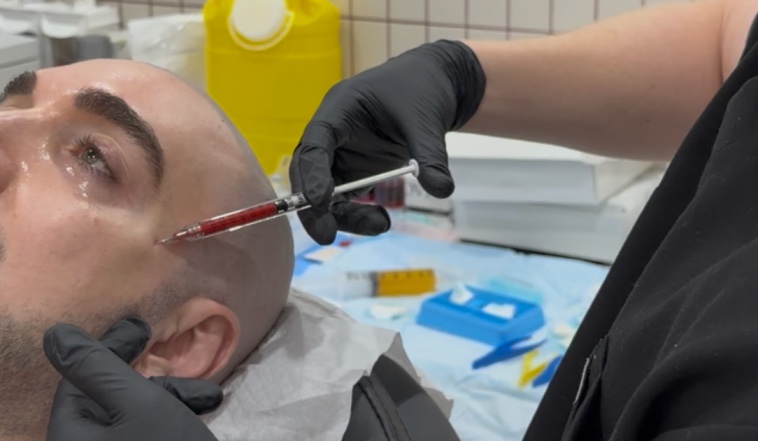
One of the most valuable tools I use when assessing tear trough concerns is ultrasound.
Ultrasound allows me to visualise structures beneath the skin in real time. Rather than relying solely on examination, I can often identify whether filler is present, where it is located and whether it may be contributing to a patient's concerns.
This allows for more informed treatment decisions and helps avoid unnecessary procedures.
A common presentation I see is a patient who has had tear trough filler previously and is seeking additional filler because the area no longer looks as good as it once did.
In many cases, adding more filler is not the answer.
If existing filler is contributing to puffiness, fluid retention or contour irregularities, adding further volume may simply worsen the issue.
Instead, dissolving the filler can provide a cleaner foundation from which to reassess the area.
Sometimes dissolving is not a setback. It is the treatment.
Despite everything I have discussed, I do not believe tear trough filler should be abandoned altogether.
When performed in carefully selected patients, using appropriate products and conservative volumes, it can produce excellent outcomes.
The key is recognising that not every under-eye concern is a filler problem and not every under-eye concern is solved with more filler.
Sometimes the answer is filler. Sometimes it is improving skin quality. Sometimes it is addressing the midface. And sometimes it is dissolving filler that is no longer serving the patient well.
As my experience has grown, my approach has become increasingly conservative. Not because I am less confident in filler, but because I am more aware of the long-term consequences of treatment decisions.
Ultimately, my goal is not to perform the most treatments. It is to help patients make informed decisions and achieve results that continue to look natural for years to come.
-
Written by Dr Brandon Kober-Brown MBBS, ProfDipMensHlth, GCCM
Registered Medical Practitioner (General Registration) MED0002581903
Disclaimer: This article is intended for general educational purposes only and should not be taken as personal medical advice. It is not a substitute for a consultation with a registered medical professional. Suitability for skin and other treatments varies between individuals and should be assessed by an appropriately qualified practitioner.


Potts Point Clinic
Shop Ground 2 / 46a Macleay Street Potts Point NSW 2011